 ChildStep
Big goals, small steps — walked together
Get the app
ChildStep
Big goals, small steps — walked together
Get the app
How families use it, and what works.
One family's summer, and the handful of habits that decide whether a goal actually gets reached. Looking for what changed in the app? That is on What's new.
Stories
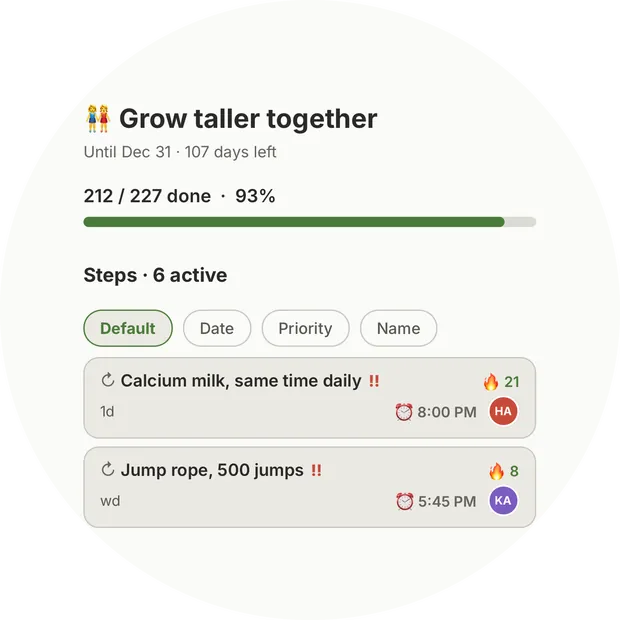
More of these are coming, ours and other families’. They will be here in the same place and the same shape as this one, and never without permission.
What makes a goal actually finish
None of this is ours (here is where it comes from). It comes from the way small teams keep work moving, and from the old advice about getting things out of your head and onto a list — rewritten for a kitchen table.
Decide what you want them to learn
Before the first goal, agree on the one under all of them. For most families it is the same two things: a child who can run their own list without being chased, and who can tell what matters most when there isn't time for all of it.
One goal at a time
Pick one and let it be the only one for a while. A family that finishes something learns it can; a family with six half-finished goals learns the opposite. Add the second when the first has a streak worth protecting.
Make the first step small enough for tonight
Ask what could happen today, not this term. Five minutes counts. Small is not lazy — it is the only size that survives a tired Tuesday, and it is what turns a plan into something that moves.
Write it down the moment you agree
Put it in the app while everyone is still at the table, with a day and a name on it. Nobody should have to carry the plan in their head. That is where nagging comes from — and it is the part the app is for.
Every step has one name on it
A step that belongs to "everyone" belongs to nobody. Give each one to a person, and let the child own theirs — including the tap that marks it done. Owning the doing is what grows the doer.
Put the fun thing on the list too
The bike ride, the game, the hour at the skate park: write it as a step, and put it last. It stops being something they're "allowed" once everything else is done and becomes the step they're working toward — the one they chose.
Rhythm, not a timetable
A goal that repeats should feel like a beat the week falls into, not a list that reads the same every morning. Let steps land on the days they fit, and when a day can't hold one, mark it skipped rather than missed. The rhythm survives; the guilt doesn't.
Five minutes on Sunday, all of you
Make it a family habit, like Sunday dinner, and give everyone the same three questions: what worked this week, what didn't, and what one thing will we change for next week? One, so you can tell what helped.
When a week goes wrong, change the plan
A missed step usually means the plan was wrong, not the child. Move the date, shrink the step, or drop it and pick a better one. A plan nobody can follow is not a plan — and changing it in front of your child teaches something worth more than the goal.
Hand them a real decision
Once in a while, give your child a plan that is actually theirs to make — where to go for the long weekend, how to fit the project around practice. Let them look into it and bring a proposal back to the table. Being trusted with a real choice teaches more than being reminded about a small one.
Three goals, worked through
These three are worked examples rather than families we have met — the practices above, in the shape of a goal you could write down tonight.
One lesson, and the small practice around it
The goal ends on the date of the swim test. The steps are the Saturday lesson, and blowing bubbles in the bath twice a week — the second one is what actually moves the needle, and it only takes five minutes. The streak on the little step is the one the child watches.
A term-long goal made of twenty-minute pieces
Two steps: read your own book for twenty minutes, and read a picture book with a parent. Both repeat daily, both belong to the child. On a heavy homework day the parent marks one skipped rather than missed — the difference is honest, and Insights keeps the two apart.
Chores that add up to something the child chose
Feeding the cat morning and evening, tidying the room on Sundays. The goal shows the percentage done, so the scooter stops being a vague promise and becomes a line that moves every week.
Where these ideas come from
The weekly family meeting and its three questions are Bruce Feiler's, from his book The Secrets of Happy Families and his 2013 TED talk, Agile programming — for your family. Rhythm over routine, the fun thing at the bottom of the list, and handing a teenager a real plan come from the families in The sage strategies of agile families by Lauren Moon on the Trello blog. The words here are ours, and so are any mistakes.